
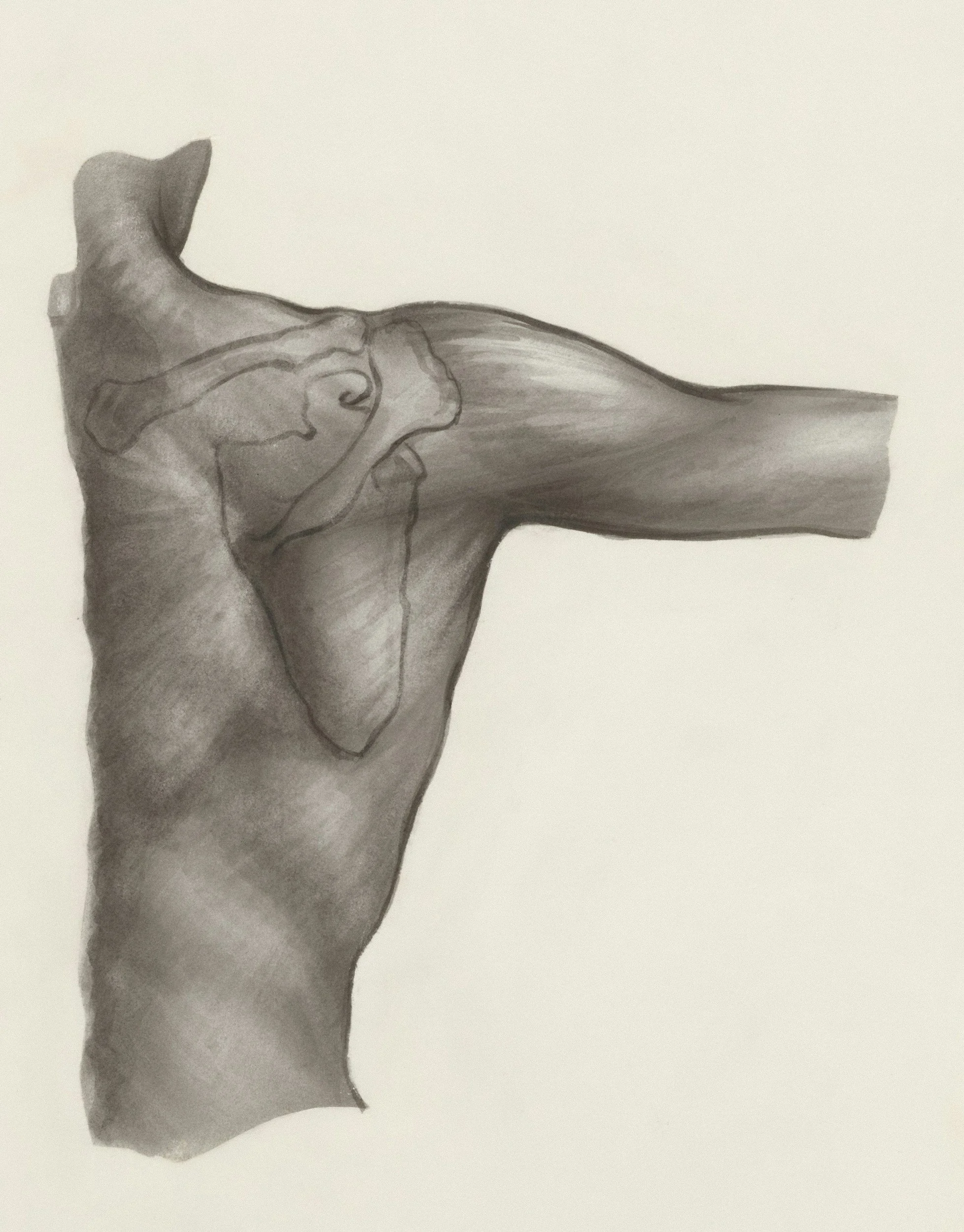
If you've had a shoulder scan, there's a good chance the report mentioned a rotator cuff tear.
And that word is scary. It sounds like something has snapped. Like the only fix is to stitch it back together.
I flew to Melbourne in October to spend a day with Dr Jared Powell, one of the world's leading shoulder researchers, and one study he shared has stuck with me ever since.
Researchers in Finland scanned the shoulders of 602 adults over 40. Plenty of them had no shoulder pain at all. Only 7 of them had a "normal" rotator cuff.¹
Seven.
Rotator cuff tears are normal. Like smile lines.
Your rotator cuff is a group of four small muscles and tendons that help control your shoulder. And just like your skin, they change as you get older.
The biggest risk factor for a rotator cuff tear isn't lifting the wrong way or sleeping on the wrong side. It's age.
I like to think of them as wrinkles in the tendon. Nearly everyone over 40 has them. Most people never know they're there.
One large study followed 1,000 women over 20 years. Almost half of those with a full-thickness tear (the kind that goes all the way through the tendon) had no pain at all.²
So if your scan shows a tear, it might be the cause of your pain. Or it might just be your shoulder being a normal, over-40 shoulder.
The scan shows us structure. It doesn't show us pain.
So why does your shoulder hurt then?
If it's not the tear, then what is it?
We've known for a few decades now that pain doesn't mean damage. That's exactly why so many of those people in Finland had tears and no pain at all.
Pain is more like a smoke alarm. Its job is to protect you, not to measure how much damage there is. Your brain is constantly taking in information. What's going on in the tissues, what you've been doing, how you've been sleeping, even what you've been told about your shoulder. Then it makes a call. Does this need protecting?
If the answer is yes, you feel pain.
And like any smoke alarm, sometimes it goes off when you've just burnt the toast.
When I see people with shoulder pain without an obvious injury, it's very rarely that something has broken. Far more often the tendons and the tissues around them have become sensitive. And nearly every time, when we dig into the story, something changed.
They went back to the gym after a few years off and went hard in the first week. They spent the long weekend painting the house. They haven't slept properly in months. Or the opposite. The shoulder hasn't been asked to do much at all for a long time, so now even small things feel like a lot.
Now imagine you've just been told your shoulder is torn. You stop lifting your arm overhead. You sleep on the other side. You give the gym a miss. It all makes sense. But slowly the shoulder gets less used to doing things, and the alarm gets even more sensitive.
Your shoulder isn't damaged and fragile. It's sensitive and protective.
And the good news is, sensitive things can be calmed down and built back up.
What actually helps a rotator cuff tear?
Here's the good news. Exercise-based physio is one of the best-supported treatments for shoulder pain.
In one long-term study, around 70 to 75 out of every 100 people with a rotator cuff tear avoided surgery over 10 years after doing a three-month exercise program.⁴
And for one of the most common shoulder operations, where surgeons shave bone to "make more room" for the tendons, a Finnish trial compared real surgery with placebo surgery. Same anaesthetic, same scars, but nothing actually done. Ten years later? No meaningful difference between the two.⁵
That doesn't mean surgery is never the answer. For some people, like those with large tears from a fall, it can be. But for most shoulders, it shouldn't be the first step.
Yet in Australia, people with new shoulder pain are sent for a scan far more often than they're sent to a physio.⁶
Shoulders take time
This is the bit nobody likes to hear.
Shoulders are stubborn. Around four months is a good recovery for a lot of people. Some take longer.
But the first six to eight weeks are where we can make the biggest change. So that's when we get stuck in.
I think it's really important to be honest about this upfront. If you expect your shoulder to be fixed in two weeks and it isn't, it's easy to think something's wrong. Usually, nothing is wrong. It's just a shoulder doing shoulder things.
Slow progress is still progress.
What this looks like in the clinic
When you come in with shoulder pain, we won't just look at your scans. We'll be looking at how your shoulder moves, what you want to get back to, and what movements feel scary or sore right now.
Then we'll find a way to get you moving. Sometimes that's gentle. Sometimes it's surprisingly heavy. Often people walk out amazed at what their "torn" shoulder could actually do.
We will make a decision together based on not just what it says on the report but what it looks like your shoulder is capable of.
Every shoulder is different, so the pathway for every one is different. But the number one goal is always to help you to feel better in your body.